Genesis AI Raises $500 Million at $3.5 Billion Valuation for Robots
Robotics startup Genesis AI raised $500 million in Series A funding at a $3.5 billion valuation. Here is who invested, how its robots learn and where they go first.
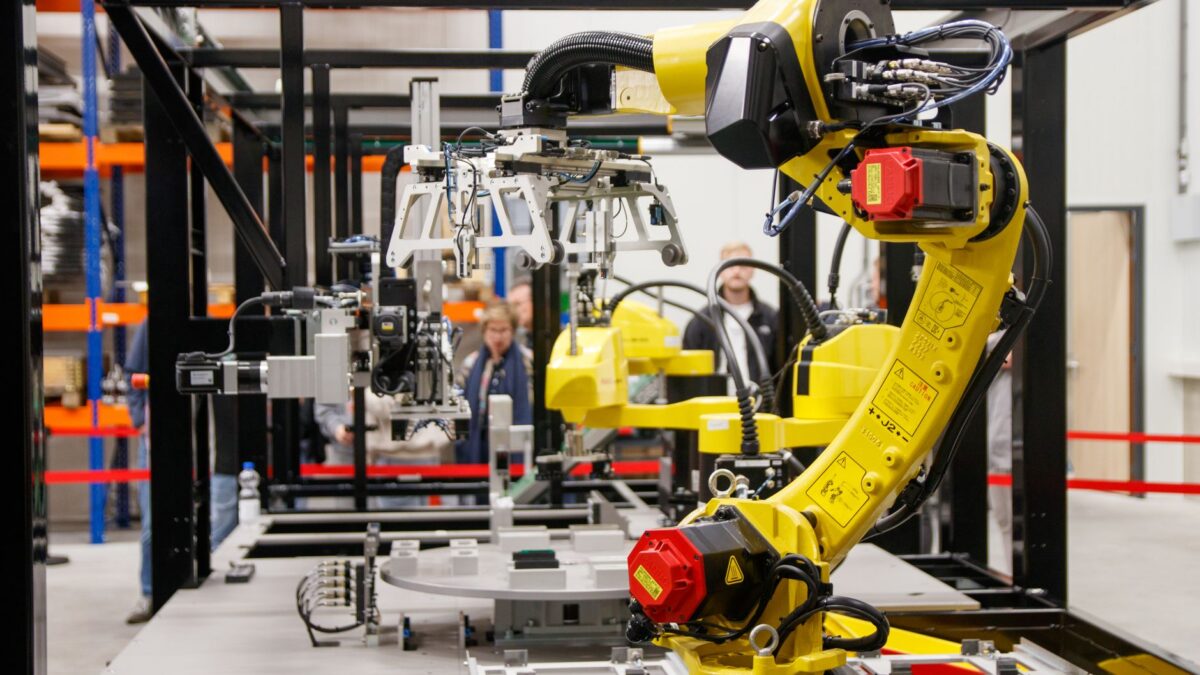
Genesis AI, a startup that trains robots by recording how people move their hands at work, said Tuesday it raised $500 million in a Series A round at a $3.5 billion valuation, according to Crunchbase News. Premji Invest, Khosla Ventures and Eclipse co-led the round.
The deal brings the company’s disclosed funding to $605 million since it was founded in 2024. Genesis raised $105 million in a round announced in July 2025. The new money will go to computing infrastructure, more robot production and hiring, co-founder and CEO Zhou Xian told Crunchbase News.
Who invested
Beyond the three lead investors, the round included T. Rowe Price Associates, Durable Capital Partners, Bpifrance, HSG, Nvidia, AMD Ventures, Zoom, Samsung Next and Ericsson. Individual backers include Eric Schmidt, Eric Yuan, Jerry Yang, Xavier Niel and Zach Kirkhorn.
Genesis has close to 100 employees. Its headquarters are in Paris, and it has offices in San Carlos, California.
How the robots learn
The company builds both the robot hardware and the AI software that runs it. Its first robot is called Eno, and it is aimed at manufacturing, logistics and laboratories.
Training data is the problem Genesis is trying to solve. Language models learn from huge amounts of text, but robots need records of physical movement and touch to learn how to pick up and handle objects. Genesis captures workers’ hand and finger movements with cameras and gloves, along with touch data, while those people do their normal jobs. The company says its robotic hand closely matches the human hand and the recording glove, which makes the movements easier to transfer. Xian said this kind of data has usually been collected by paying people to steer robots remotely.
The recordings train the company’s AI model, GENE. Genesis also runs a simulation product, Genesis World, where robots practice skills in virtual settings before trying them on real machines. The company says this is faster than training on physical robots alone.
From university project to company
Genesis began as a research collaboration Xian started in 2022 while working on a robotics Ph.D. at Carnegie Mellon University. Researchers from more than a dozen universities worked on simulation tools under the same name. Xian finished his degree at the end of 2024, teamed up with Theophile Gervet, and the company formally launched in March 2025, adding AI software and hardware to the simulation work.
“In the end, this is a very full-stack company,” Xian told Crunchbase News, explaining that the company builds every layer itself.
What it means for customers and the robotics market
Genesis is looking at a rental model, where businesses would pay for the robot and its software together as one service. It has announced a partnership with LG CNS and says other Fortune 500 companies are in its pipeline of possible customers. Xian declined to disclose revenue or the number of paying customers.
Premji Invest partner Vedant Agrawal said in a release that the firm was drawn to demonstrations of robots finishing long tasks on their own. Reliable task completion “is what turns a robot into something a business can rely on,” he said.
The round lands in a strong year for robotics investors. Global venture funding to robotics startups reached $9.9 billion in the third quarter, more than double the $4.3 billion invested in the same quarter of 2025, according to Crunchbase data. Most of that money went to companies in China and the U.S.
What comes next
Genesis says it is increasing Eno production for industrial customers. After factories, warehouses and labs, the company plans to move into hospitality and healthcare, and later into consumer and outdoor uses. It has not given dates for those steps.
Source: Crunchbase News